Description
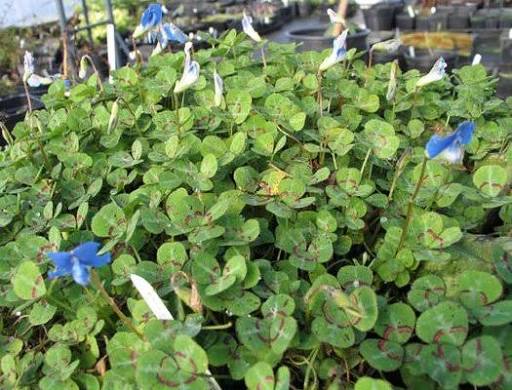
Parochetus communis — commonly known as Shamrock Pea or Blue Oxalis — is a rare, creeping perennial legume prized for its vivid blue, pea‑shaped flowers and neat clover‑like foliage. It is the only species in its genus and has a distinctive alpine–woodland character that makes it highly desirable for collectors and shade‑garden enthusiasts.
🌿 Detailed Description
Parochetus communis is a low‑growing, prostrate herb forming a dense, creeping mat. Mature plants typically reach 10–20 cm tall and spread 30–40 cm, making them ideal for groundcover in moist, shaded areas.
Its trifoliate leaves resemble clover, each leaflet measuring 8–20 mm long, occasionally up to 40 mm. Leaflets are wedge‑shaped at the base, notched at the tip, and may be either smooth‑edged or minutely toothed. The undersides are lightly hairy, giving the foliage a soft texture.
🌸 Flowers
The flowers are the plant’s standout feature:
- Colour: Usually deep blue, occasionally white or purple.
- Form: Classic papilionaceous pea‑flowers with a notched upper petal (standard).
- Size: Standard petal 12–20 mm; keel 20–25 mm long.
- Arrangement: Borne singly or in clusters of up to three on slender stalks 8–15 cm long.
Flowering occurs April to November in suitable climates, giving an unusually long season for such a small alpine species.
🌱 Growth & Habit
- Height: 10–20 cm
- Spread: 30–40 cm
- Habit: Creeping, mat‑forming
- Foliage: Evergreen in mild climates; may defoliate periodically
- Nitrogen‑fixing: Yes — as a member of Fabaceae, it enriches soil.
🌤 Position & Conditions
Parochetus communis is native to mountain forests and stream edges across the Himalayas, China (Sichuan, Yunnan), Java, and tropical East Africa. It thrives in:
- Light: Partial shade to full shade
- Soil: Moist, humus‑rich, well‑drained
- Moisture: Consistent moisture; dislikes drying out
- Exposure: Sheltered, cool conditions
- Altitude: Naturally found at 900–4000 m
❄️ Hardiness
This species is tender in the UK, surviving outdoors only in warm, sheltered microclimates. Plants from Asian populations may be slightly hardier than African ones.
USDA zones 9–11 are recommended; it tolerates only light frost.
🌿 Ecology & Distribution
- Native to: Himalayas, China, Java, East African mountains
- Habitat: Damp forest floors, stream banks, shaded grasslands
- Conservation status: Least Concern (IUCN) due to wide distribution
🛠 Care & Maintenance
- Keep soil consistently moist
- Provide shade and shelter
- Ideal for woodland gardens, alpine troughs, and shaded rockeries
- Propagation: Division or seed (seeds require soaking)

Reviews
There are no reviews yet.