Description
🌿 Identity & Habit
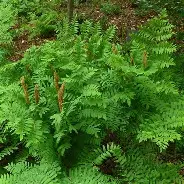
Osmunda regalis is a large, deciduous, clump‑forming fern with a bold, architectural presence. It grows from stout, ascending rhizomes that gradually form a woody, trunk‑like base over many years.
Its fronds arise directly from this rhizome, forming huge, elegant rosettes. The plant produces sterile fronds and fertile fronds, the latter often referred to as “flowering” due to their distinctive appearance.
📏 Size
- Height: Typically 1.5–2.5 m in garden conditions; fronds can reach 120 cm, and exceptionally up to 400 cm in the wild.
- Spread: 0.5–1 m, forming a substantial clump.
🌱 Fronds & Fertile Structures
- Fronds are bipinnate, 30–40 cm wide, with 5–9 pairs of pinnae. Each pinna carries 7–13 pairs of pinnules.
- Young fronds emerge covered in golden‑brown hairs, becoming smooth and pale green as they mature.
- Fertile fronds bear rusty‑brown spore‑bearing pinnae at their tips; the blade is reduced almost to the midrib and densely covered with sporangia.
- Unusually, fertile fronds may appear in autumn, not spring or summer, in some populations.
🌍 Distribution & Habitat
Osmunda regalis is native to Europe, North Africa, and West Asia, and occurs almost cosmopolitanly across many continents except Australia and New Zealand.
It grows in:
- Woodland bogs,
- Streambanks,
- Wet meadows,
- Constantly moist, high‑light forest edges.
It prefers wet, humus‑rich soils and often forms large colonies where rhizomes are bathed in running water.
🌤 Growing Conditions
- Light: Full shade, partial shade, or even full sun if moisture is abundant.
- Soil: Chalk, clay, or loam; moist to poorly drained; acidic, neutral, or alkaline.
- Moisture: Requires constant moisture; ideal for boggy or water‑side planting.
- Hardiness: Rated H6 — hardy to –20°C to –15°C in the UK.
- Time to maturity: 5–10 years.
🛠 Care & Maintenance
- Remove dead or damaged fronds as needed.
- Easy to grow in cool, moist, lightly shaded sites.
- Propagate by division or sowing spores when ripe.
- Excellent for very wet sites and naturalistic plantings.
🌿 Garden Uses
- Woodland gardens
- Bog gardens
- Streamside planting
- Underplanting shrubs
- Wildflower meadows
Its stately size and upright fertile fronds make it a dramatic architectural fern.

Reviews
There are no reviews yet.