Description
🌿 Acer palmatum Hybrids — Detailed Botanical Description
Identity & Origin
Japanese maples (Acer palmatum) have been cultivated for centuries in Japan, with hundreds to over 1,000 named cultivars now in commerce. Hybrids arise either from deliberate breeding or natural variation within this highly mutable species complex. Their variability is so extreme that no tree species has been more variable in cultivation .
Hybrids may incorporate traits from:
- Acer palmatum (the base species)
- Distinct cultivar groups (e.g., upright × dissectum crosses)
🍁 Morphology & Habit
Size & Structure
Hybrids range widely, but most fall within the typical Japanese maple size:
- Height: 10–25 ft in cultivation (3–7.5 m)
- Spread: 10–25 ft (3–7.5 m)
- Growth rate: Slow to moderate
- Lifespan: Long‑lived, often several decades
This breadth of habit is one of the defining features of hybrid Japanese maples.
🍃 Foliage Characteristics
Hybrid foliage is extraordinarily variable:
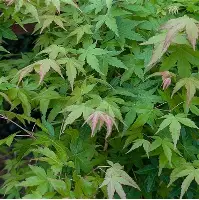
- Leaf shape: From shallowly lobed to deeply dissected laceleaf forms
- Leaf colour: Green, burgundy, purple, variegated, or multi‑tone
- Seasonal change:
- Spring: fresh greens, reds, or purples
- Summer: stable colour (though purple types may fade in strong sun)
- Autumn: gold, orange, scarlet, often among the most brilliant of any small tree
Hybrids often combine traits—e.g., upright habit with laceleaf foliage, or dissected leaves with stronger summer colour retention.
🌸 Flowers & Fruit
- Bloom time: April (small red or yellowish flowers)
- Fruit: Winged samaras, typically red‑tinged
- Flowers are subtle and ornamental mainly at close range.
🌱 Cultivation Requirements
Light
- Sun to part shade is ideal.
- Morning sun + afternoon shade produces the best foliage in warm climates.
- Full afternoon sun in zones 7–8 causes leaf scorch, especially in purple‑leaf hybrids .
Soil
- Well‑drained soil is essential.
- Prefers slightly acidic pH (5.5–6.5) but tolerates neutral soils .
Water
- Moderate moisture; dislikes waterlogging.
- Mulch helps keep roots cool in summer (important for red/purple hybrids) .
Hardiness
- Generally hardy in zones 5–8 (UK equivalent: H5–H6) .
- Zone 4 possible only with exceptional shelter; zone 9 only in mild coastal climates.
Siting Essentials
Across all hybrids, site selection matters more than variety selection:
- Avoid hot western sun
- Protect from cold winter winds
- Ensure real drainage, not aspirational drainage
🐛 Pests & Diseases
Japanese maple hybrids share the same vulnerabilities as the species:
- Verticillium wilt — the only truly serious disease; soilborne and persistent with no chemical control
- Cosmetic issues: aphids, scale, leaf scorch, mildew
- Most problems in August are siting issues, not disease
🎨 Ornamental Value
Hybrids are prized for:
- Exceptional foliage colour and autumn display
- Architectural branching
- Suitability for small gardens, containers, courtyards, and Japanese‑style landscapes
- Ability to provide year‑round interest even when not in leaf (e.g., coral‑bark types like ‘Sango Kaku’)
🧬 Why Hybrids Matter
Hybridisation expands the palette beyond what the species alone offers:
- Stronger summer colour retention
- Improved cold or heat tolerance
- Unique leaf textures
- Compact or columnar forms
- More reliable performance in varied climates


Reviews
There are no reviews yet.